Denbigh's Boiler
The following description of Denbigh's
boiler is adapted from
a longer essay by Denbigh Project volunteer Gene Shimko.
Denbigh was fitted with a single, large,
boxlike boiler. This boiler design, very common aboard seagoing steam vessels of the
1850s, was superseded by the familiar cylindrical "Scotch" boiler design,
introduced in the 1860s. Denbighs boiler operated at a designed pressure of
22 lbs. (about 1.5 atmospheres above ambient), which was near the maximum pressure for
this type of boiler construction.
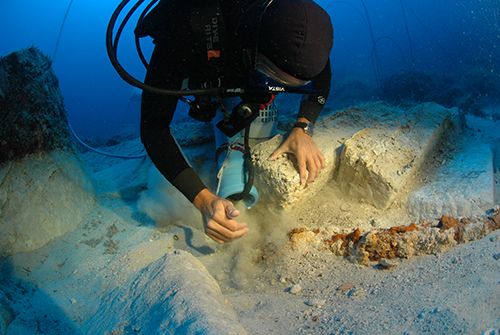
Denbighs boiler has not been excavated, but
the type is well documented in contemporary engineering texts and journals. The lower part
of the boiler probably had three or four coal-fired furnaces opening on its aft face.
These opened to a shared combustion chamber at the back (i.e., bow-facing) end of the
boiler. From the combustion chamber, hot exhaust gases from the fireboxes were directed
through a series of horizontal fire tubes, three to four inches (7.5 to 10cm) in diameter,
running aft again through the main body of the boiler, which was filled with water. At the
aft end of the fire tubes, the exhaust gases then flowed through a metal casing into
another series of tubes, these aligned vertically in a "superheater," and from
there exited though the single, narrow funnel of the vessel.
Denbighs boiler would have operated with
sea water. The salt in sea water would eventually cause scale and corrosion in the boiler
and other compartments, but the salt would be retained within the boiler as the steam
pure water was diverted to the engines. Once spent, this steam would be
condensed and returned to the boiler. This "closed loop" system helped to ease
the problems of corrosion in the boiler. The salinity of water in the boiler would have
been checked frequently, and when it rose above a certain level part of the water in the
boiler would have been blown out, and new, clean sea water pumped in to replace it.
Although Denbigh was noted for her high speed in
civilian service, by the time she was running the blockade in 1864-65 she was known on
both sides as a relatively slow ship, depending on stealth and daring more than speed. In
1864 the acting U.S. consul-general in Havana, Thomas Savage, attributed this to her
boiler being "in a bad condition."
The superheater is one of Denbighs most
interesting features. The superheater on the Denbigh was located just above the
boiler and made use of the waste heat in the boiler flue hot exhaust gases. The hot gases
were routed through a bundle of vertical tubes around which the boiler steam was
circulated. The superheater increased the temperature of the saturated steam that the
boiler produced. For a given pressure, the boiler produces steam at a certain temperature.
Steam just barely exists at this "saturated" temperature and will readily
condense on any surface that is at a lower temperature. Many steam engine designs suffered
from this condensation effect; the steam could partially condense in the pipes leading to
the engine cylinders if the pipes were not effectively insulated, and could also partially
condense in other passages before entering the cylinder. The most troublesome problem was
that the steam would condense in the engine cylinders themselves during the expansion as
the piston moved. All this premature condensing greatly decreased engine efficiency.
Superheated steam prevents premature condensation because more heat has been added to the
steam to raise it above its saturation point. Superheat also increases the overall
thermodynamic efficiency of the steam engine because there is more heat to convert to
work. Some superheaters of the period could raise the temperature of the steam by about
100° F, and create a fuel saving of up to 20%.

Denbigh's superheater is similar
to Parson's superheater, shown here in an article from the British journal The
Engineer of April 12, 1861.
The introduction of superheated steam to marine
powerplants was very new in 1860, and its use aboard Denbigh is an important
indicator of the builders willingness to invest in the most advanced, up-to-date
technologies of the period. Denbighs tubular superheater is broken and
partially collapsed into the main body of the boiler, but it appears to be very similar to
Parsons superheater, introduced the year after Denbigh was built. In
Parsons design, two valves on the aft side of the superheater casing allowed steam
to pass directly from the upper part of the boiler into the cylindrical superheater. The
steam circulated around the superheater tubes and exited the superheater via another
valve, from which piping carried the live steam to the engines and other, auxiliary
machinery.
|