Archaeological Preservation Research Laboratory Report 1:
Silicone and Polymer Technologies: An Additional Tool in Conservation
C. Wayne Smith
Conservation Research Laboratory/Archaeological Preservation Research Laboratory
Texas A&M University
-----------------------------------------------------------------------------------------------------------------
When considering a conservation strategy, the best long-term interest of an artifact should always be the main concern. Too often this objective is compromised because a conservator is forced to choose a less-than-satisfactory treatment. Cost constraints or lack of experience may account for such a circumstance, but inadequate conservation strategies can also play a role in choosing an inappropriate treatment. Often applying traditional conservation technologies is undesirable because they can place undue stress on archaeological materials. Recognizing this problem, the Conservation Research Laboratory at Texas A&M University has adopted silicone and polymer technologies in artifact conservation. For the past five years, research has been conducted in the use of polymer media for the stabilization and consolidation of organic materials.
The issue of reversibility has often been used as an argument against such new technologies. Reversibility is indeed a desirable aspect of any conservation process. Unfortunately the theoretical state of reversibility outweighs some of the more important issues in artifact conservation. Indeed, the reality is that no conservation strategy can guarantee complete reversibility, for example; in many instances it is impossible to remove all of the polyethylene glycol (PEG) from conserved waterlogged wood because it becomes chemically bonded to the remaining lignin within the cellular structure. Moreover, the removal process itself causes additional damage, since PEG can also become trapped in wood's cellular voids. In other words, the use of PEG as a conservation method can undermine the structural integrity of wood.
In contrast, new processes utilizing silicone and polymer technologies to treat waterlogged wood do not cause cellular distortion. In most cases, post-treatment genus and species identification is possible.
The life expectancy of treated artifacts with traditional processes has been overstated. Many routine treatments produce artifacts with a relatively short life expectancy, for example; PEG-treated wooden artifacts tend to become unstable over times due to the water miscibility of PEG. Intracellular flow and surface pooling can cause distortion of diagnostic features and extensive damage to artifacts. Even in very controlled environments, PEG breaks down.
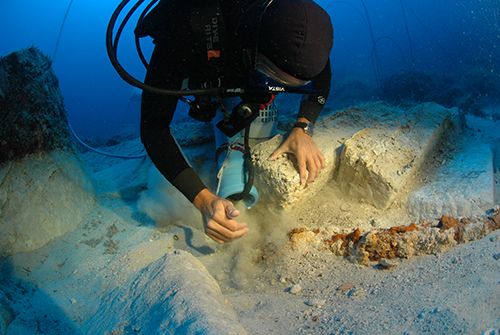
The expected longevity of silicone and polymer processes is not an issue. Through extensive testing and nearly 25 years of data collected by the silicone and polymer industries has proven the minimum life expectancy of these materials to be 200 years. Short treatment times, as well as minimal necessary curation, are additional advantages. For example, the treatment time for the conservation of delicate glass beads recovered from the Uluburun shipwreck (1300 B.C.) was approximately 20 minutes. Once completed, these beads required only a few hours of uninterrupted curation before they could be safely handled for study.
By conforming only to traditional technologies, the conservator may never discover new and perhaps better ways of treating artifacts. Knowledge acquired through research at the Texas A&M University Conservation Research Laboratory (CRL) and the Archaeological Preservation Research Laboratory (APRL) has aided in the discovery of new techniques to be used in conjunction with well established conservation methods. For example, CRL/APRL researchers have proposed new methods of removing a substantial portion of unstable PEG from treated artifacts while reconstituting the remaining bonded PEG into a more stable bulking material.
Investigating the use of silicone and polymers for the preservation of archaeological materials is a reality. These new technologies are not a panacea for all conservation needs, but they should be viewed as an important addition to the conservator's tool kit.
The contents of this site-text, images and data-are intended for personal information only. Downloading of information or graphic images contained herein for private use is not discouraged; however written from NAP is required for the publication of any material. Any use of this material should credit the Nautical Archaeology Program, Texas A&M University. For additional details contact C. Wayne Smith ((silicone@tamu.edu).