HISTORICAL ARCHAEOLOGY

Anthropology 313
Spring 2005

Tentative Course Schedule
Subject to revisions and refinements, which will be posted on the on-line syllabus.
Use the on-line syllabus for the latest web links and reading assignments.

Class Room: Anthropology Buidling, 130, 2:20-3:35 P.M. Tuesday, Thursday
Instructor: Donny L. Hamilton
Office: Room 102B or 124, Anthropology Building
Phone: 845-6355
E-mail: dlhamilton@tamu.edu
Office Hours: 10 a.m. - 12 p.m. Monday & Wednesday, or by appointment

Class Information:  http://nautarch.tamu.edu/class/313/
Class syllabus: http://nautarch.tamu.edu/class/313/313syl.htm

Historical archaeology has been defined in a number of ways. Perhaps the simplest definition is the one that holds that "Historical archaeology is the study of the remains from any historic period." A historic period is any period in which the cultures in question have a documentary record and in which writing has a full impact both on the culture being studied and in the scholarship of the investigation. As applied and defined in this course, historical archaeology is the study of European Cultures (generally Western European) and their spread into the New World from post-1500 to the recent past. However, the spread of Asian and African cultures into the New World are also included. In historical archaeological research, written documentation usually contributes as much to the research as the archaeological excavations and material culture. In fact, historical archaeology is an intimate marriage of archaeology, material culture, and documents. A range of cultures, time periods and material culture are represented. The intent is to present to the students in the class an overview of the subject through lectures, films, slides, covering a selection of historic sites that represent the types of research being conducted in historical archaeology. As much as possible, the subject of historical archaeology will be presented by using examples from recent research. Accordingly, the internet will be used extensively for topical examples to exemplify historical archaeology research. If you do not have a personal computer, then you can access the web pages at the library computer center.

Emphases: 16th - 17th-Century Historical Archeology
1554 Plate Fleet, Padre Island, Texas, Spanish ships
Jamestown, Virginia (1607), earliest English settlement in the New World
Port Royal, Jamaica (1655-1692), sunken English city
La Belle (1686), Matagorda Bay, Texas, French ship
Plimouth, Massachusetts (16- ), English settlement

TEXT:
Approaches to Material Culture Research for Historical Archaeology, David R. Brauner, Compiler

SELECTED ASSIGNED READINGS FROM:
In Small Things Forgotten, by James Deetz
Post-Medieval Pottery 1650-1800, by Jo Draper
A Guide to the Artifacts of Colonial America, by Ivor Noel Hume
Historical Archaeology: A Guide to Substantive and Theoretical Contributions, ed. by Robert L. Schuyler
Archaeological Perspectives on Ethnicity in America, ed. by Robert L. Schuyler
Text Aided Archaeology, ed. by Barbara J. Little.
Studies in Material Culture Research, Karlis Karklins, Editor.

INTERNET -- ARCHAEOLOGY LISTS

Discussion Groups:
ARCH-THEORY - Discussion on archaeological theory. To subscribe send a message to Mailbase@mailbase.ac.uk with the words, "Join ARCH-THEORY your name
ARTIFACT - Exchange of views on material culture. To subscribe send a note to LISTSERV@UMDD.UMD.EDU
HISTARCH - Discussion group on Historical Archaeology. Send a note to Listserv@asuvm.inre.asu.edu

RELEVANT ARCHAEOLOGY WEB PAGES

Nautical Archaeology -- http://nautarch.tamu.edu

ARCHNET (lots of links & subject areas, historical archaeology being one
http://archnet.asu.edu/

Historical Archaeology Section of ARCHNET:
http://archnet.asu.edu/archnet/topical/historic/historic.html

FILMS: (tentative)
Other People's Garbage
Jamestown Rediscovery
Search for a Century - Wolstenholm
1554 Plate Fleet
Port Royal, City Under the Sea
The Shipwreck of La Belle (La Salle's Shipwreck in Texas)
The Skeletons of Spittlefield.
Digging Up Slaves
Genealogy by Genetics

TENTATIVE SCHEDULE
For the latest version of the course syllabus, see: http://nautarch.tamu.edu/class/313/
with links to internet reading assignments.

Week 1, Jan 11, 12: INTRODUCTION AND BASIC TERMS
Introduction
Film: Other People's Garbage & Discussion
Text Book, read pp. v-vii, 1-7.

Week 2, Jan 18, 20: FINDING, EXCAVATING, AND DATING HISTORICAL ARCHAEOLOGICAL SITES

Week 3, Jan 25, 27: ENGLISH CERAMIC HISTORY
Thursay, Film - Jamestown Rediscovered
Text Book, A Vessel Typology for Early Chesapeake Ceramics, The Potomac Typological System., pp 11-36
Deetz, All the Earthenwared Plain and Flowered, In Small Things Forgotten, pp. 46-61.
Post-Medieval Pottery 1650-1800 by Jo Draper
INTERNET:
Tin-glazed earthenware:
http://nautarch.tamu.edu/portroyal/tinglaze/index.htm
Chamber Pots: [REVIEW ARTICLE]
http://nautarch.tamu.edu/portroyal/CHAMBER/Index.htm
Borderware:
http://nautarch.tamu.edu/portroyal/border/index.htm
Slipware:
http://nautarch.tamu.edu/portroyal/slipware/index.html
North Staffordshire Pottery:
http://www.thepotteries.org/pottery.htm

Week 4, Feb 1, 3: EARLY VIRGINIA EXCAVATIONS:
JAMESTOWN & WOLSTENHOLM
Deetz, Chpt. 2, The Anglo-American Past
INTERNET:
Vernacular House Forms:
http://www.people.virginia.edu/~jfd3a/Plymouth/folkhouse.htm

Jamestown, Wolstenholm and Plimouth, three early 17th-Century English Sites
Jamestown Excavations home page with links to history, excavtion areas, burials, and artifacts:
http://www.apva.org/jr.html
Film - Search for a Century & Discussion
Nat. Geog. June 1979, Vol. 155, No. 6, pp. 735-767.
Nat. Geog. January 1981, pp. 53-77.

Week 5, Feb 8, 10: HISTORIC DOCUMENTS AND GENEALOGY RESEARCH

Simon Benning, Pewterer of Port Royal, pp. 39-54, Text-Aided Archaeology, ed. Little.
or on the Internet at: http://nautarch.tamu.edu/portroyal/research.htm#SIMON
"Following the Written Record Trail" and Genealogical Research - an example of what you might discover and how to go about it
On the Internet - The Ross-Hamilton Records:
http://nautarch.tamu.edu/class/313/ross/census.htm
http://nautarch.tamu.edu/class/313/ross/ross-inv.htm
http://nautarch.tamu.edu/class/313/ross/admission.htm

Genealogy Assignment:
Go to Evans Library and find one of your ancestors in the 1850-1930 US Census (the earlier the better) and print the page. Go to the Internet and download the pedigree chart at: http://nautarch.tamu.edu/class/313/genealogy/pedchart.htm
and the family group record at: http://nautarch.tamu.edu/class/313/genealogy/fgr.htm
The family group record is provided to add additional information on the entire family of each generation. A separate family group record is used for each generation.
Fill out the charts as well as you can, starting with yourself. Then go to one of the following web sites and conduct a search to see if you can find any connections to any of the names in your family.
Ancestry.com - http://www.ancestry.com/search/main.htm
FamilySearch.com - Church of Latter Day Saints - http://www.familysearch.org/
Family Tree Maker - http://www.familytreemaker.com/

Follow out any leads you find and print out each lead. You are more likely to find a connection the further back in your genealogy you can go, such as your great grandparents or great great grandparents. Using the data on your chart and the US Census, find a minimum of two more records such as a marriage record, death record, probate records, deed record on the same relative.

Try to find one of your ancestors in a US Census, 1850 - 1930. If you cannot find any of your own ancestors, then use someone that is somehow related -- such as someone with the same surname in the same locality as your relatives. If necessary, use a historic figure as a last resort. Write a report on your search and findings. Point out any revelations or insights the research contributed to your understanding of your family and the relevance of genealogy to historic research.

If you find any hits on your searches on the Internet, you can arrange with me to search the files of genealogy.com for material that is available in their databases. All the images of the US Censuses are available as well as many state and county records.

The1930 US Census is the latest to be released. If your family is from Texas or the South, the TAMU Evans Library has all the census records for Texas and many of the southern states. Also, the Carnegie Library in Bryan has many of the census records. This exercise is intended to expose you to the basic documents used in genealogical research that is conducted when one excavates a historic site. This Genealogy Exercise is due on March 10, 2005

Film: Genealogy by Genetics
INTERNET:
Historic Documents related to the Plimouth, Massachusetts: Archival Project
http://www.people.virginia.edu/~jfd3a/
Glossary of Terms
http://etext.lib.virginia.edu/users/deetz/Plymouth/GLOSSARY.htm
Seminar Reports:
http://etext.lib.virginia.edu/users/deetz/Plymouth/seminar.html
Plimouth Probate Records:
http://etext.lib.virginia.edu/users/deetz/Plymouth/probates.html
Selected Wills:
http://etext.lib.virginia.edu/users/deetz/Plymouth/wills.html
Vernacular House Forms: [REVIEW ARTICLE]
http://etext.lib.virginia.edu/users/deetz/Plymouth/folkhouse.htm
Material Culture of Plimouth
http://etext.lib.virginia.edu/users/deetz/Plymouth/material.html
Sexual Misconduct: [REVIEW ARTICLE]
http://www.people.virginia.edu/~jfd3a/Plymouth/Lauria2.html


Review Article Assignment: Select one of the three Internet Research Articles and write a two page report on how the attitudes and practices of the time time are reflected. Due on March 31, 2005.

Week 6, Feb 15, 17: PORT ROYAL JAMAICA EXCAVATIONS ARCHITECTURE
Text Book Naill Chronology: The use of Technologically Derieved Features, pp. 318-339
The Bare Necessities: Standard of Living in England and the Chesapeake, 1650-1700, pp. 381-398

Port Royal, Jamaica, A Late 17th-century English Site
Port Royal History/Excavations Web Page
http://nautarch.tamu.edu/portroyal/
Read: Hamilton, Archaeology, Jan./Feb. 1984, Vol. 37, No. 1 and Science Year 1986,
Port Royal Excavation - PowerPoint
Architecture, Brick Buildings

Deetz, Chpt. 5, pp. 92-117, I Would Have the Howse Stronge in Timber
Can also be found on ARCHNET at:
http://www.people.virginia.edu/~jfd3a/Plymouth/house.html
Vernacular House Forms:
http://www.people.virginia.edu/~jfd3a/Plymouth/folkhouse.htm

WEEK 7, Feb 22, 24: continue ceramics
First Exam, Tuesday, Feb. 22.

Chages in Pearlware Dinnerware, 1780-1830, pp. 35-43
British Military Tableware, 1760-1830
Deetz, Chpt. 3, All the Earthenware Plain and Flowered
Mean Ceramic Dating

Week 8, Mar 1, 3: OTHER MATERIAL CULTURE
Smoking, pipes, pewter, firearms, gunflints, gravestones, etc.
Text Book: The Role of Pewter as Missing Artifact, pp. 248-274
Gunflints: A Study, pp. 340-372

Deetz, Chpt. 4, Remember Me as You Pass By, Small Things Forgotten, pp. 64-90
Smoking Pipes for the Archaeologist, Charles S. Bradley,
in Studies in Material Culture Research, Karlis Karklins, Editor, pp. 104-133

Week 10, Mar 8, 9:
Deetz, Chpt. 6, Small Things Remembered, 120-136
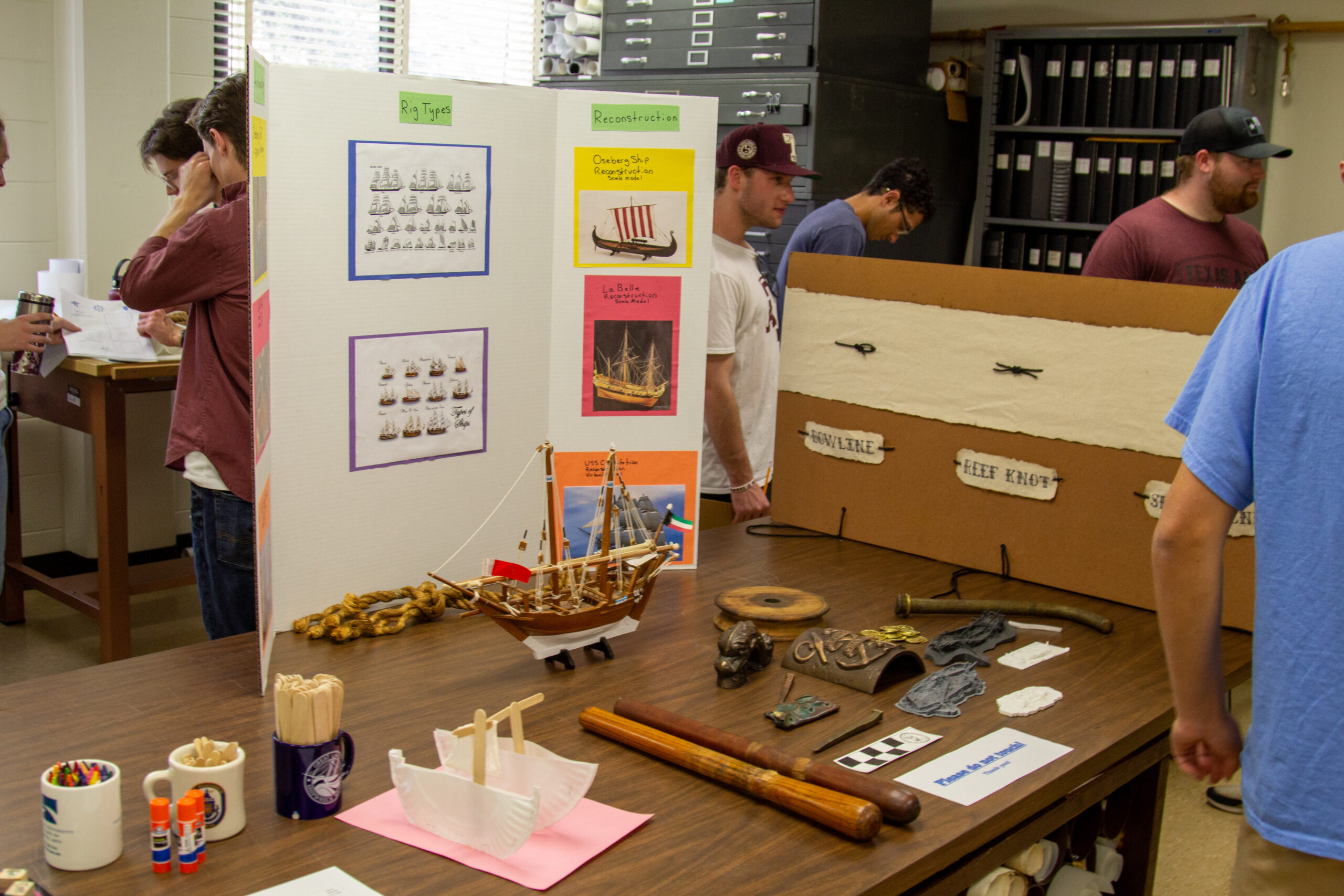
Thursday, Class tour of Conservation Research Laboratory
Class will meet in Room 101, Anthropology Building.
Display of artifacts from Port Royal, Jamaica,
La Belle and other sites.

Week 10, Mar15, 17 - SPRING BREAK

Week 11, Mar 22, 24: TEXAS SHIPWRECK EXCAVATIONS
1554 PLATE FLEET EXCAVATION, PADRE ISLAND, TEXAS
LA BELLE EXCAVATION, MATAGORDA BAY, TEXAS
CONSERVATION

The 1554 Spanish Plate Fleet
Read: Shipwreck in the Wake of Columbus, Section IV, pp. 102-111 by J. Barto Arnold,
in Archaeology Underwater, ed. Keith Muckelroy.
Slides/Film on the 1554 Fleet excavations in Texas
1554 PowerPoint Presentation

La Salle's Ships
La Belle and L'Aimable, 1784-86
http://www.thc.state.tx.us/Belle/index.html
Chronology of events, Who was La Salle, King Louis XIV, Le Comte de Vermandois,
Naval artillery, flags, Site of Ft. St. Louis.
Film: Voyage of Doom, NOVA
Explore the Shipwreck, by Steve Hoyt:
http://www.pbs.org/wgbh/nova/lasalle/shipwreck.html
Stories in the Timbers, by Toni Carrell:
http://www.pbs.org/wgbh/nova/lasalle/timber.html
Who Owns Shipwrecks?:
http://www.pbs.org/wgbh/nova/lasalle/owners.html
Conservation:
http://nautarch.tamu.edu/napcrl.htm
Look at Reports 1, 2, 3, 4, 5, and 7.

WEEK 12, Mar 29, 31:SHIPWRECK EXCAVATIONS - continued

WEEK 13, April 5, 7: SKELETAL ANALYSES
Second Examination, Tuesday, April 5, 2005
Special Analyses, Excavation of "holes"
Privies, Cisterns, Wells, Graves: Skeletal material
Film: The Skeletons of Spittlefield.
Jamestown, Virginia Rediscovery Web Page - Jamestown skeleton:
http://www.apva.org/finding/grave.html
La Belle Skeleton:
http://nautarch.tamu.edu/CRL/Report4/skeletal.htm

WEEK 14, April 12, 14: ETHNIC ARCHAEOLOGY/CURRENT TRENDS
THE ARCHAEOLOGY OF GROUPS - SLAVERY
Film: Digging up Slaves
Text Book, read Status and Cermics for Planters and Slaves, pp. pp. 111-138
What is the use of Plantation Archaeology, pp. 407-322
Material Culture and African-American Spirituality at the Hermitage, pp.423-439
Blue Beads as African Cultural Symbols, pp. 221-247

Deetz, Chpt. 7, Parting Ways, pp. 138-154 in Small Things Forgotten

Andrew Jackson, Excavations at the Hermitage, Slave Archaeology::
http://www.earthwatch.org/ed/mckee/mckee.html

Excavations of slave cabins near the Hermitage:
http://www.earthwatch.org/ed/mckee/triplex.html

Excavations of field slave cabins at the Hermitage:
http://www.earthwatch.org/ed/mckee/fieldquarters.html

Levi Jordan Plantation: UNRAVELLING THE 1850 and 1860 SLAVE SCHEDULES, by Spencer McCall
http://www.webarchaeology.com/html/slavschd.htm

WEEK 15, April 19, 21: 19th-Century Archaeology
Gender Archaeology, Assignment pending.
Richard Carter Ranch Site, College Station, TX
http://nautarch.tamu.edu/class/313/

19th-Century Archaeology - The Reed Farmstead Archaeological Site, Hardy County, West Virginia
http://www.reedfarmstead.com/html/introfr.htm
Conclusion
Deetz, Chpt. 8, pp. 156-161, In Small Things Forgotten
Make up exam April 21, 2005.
Only students making up an examination need to attend class.

WEEK 16, April 26, 28: Thursday Last Day of Class.
19th-20th-Century Archaeology
Beer Cans: A Guide for the Archaeologist, pp. 290-308

Examination Schedule (tentative)
1st exam, Tuesday, Feb. 22, 2002
Genealogy Exercise, March 10, 2005
Internet Reseach Article Review, March 31, 2005
2nd exam, Tuesday, April 5, 2005
Make-up examination day, April 21, 2005
Final Examination: May 11, Wednesday, 1-3 p.m for classes meeting TR 2:20-3:35 p.m.

Course Grade Determination: Each student's grade will be based on his/her performance on two semester exams (25% each for a total of 50%), the genealogy exercise (10%), research article review (10%), and a final exam (30%). Class attendance and active participation is expected. Reading assignments are to be completed before the topic is discussed in class. Excessive absences, normally more than 3, will result in the elimination of any curve or adjustment that may be given on any exam. A curve is given to balance any inequities that may result among students who attend class regularly. If you miss a lot of classes, a poor grade is the result of not attending class, not some inequity in the test itself.

Plagiarism:
The handouts used in this course are copyrighted. By "handouts," I mean all materials generated for this class, which include but are not limited to syllabi, quizzes, exams, lab problems, in class materials, review sheets, and additional problem sets. Because these materials are copyrighted, you do not have the right to copy the handouts, unless I expressly grant permission.
As commonly defined, plagiarism consists of passing off as one's own the ideas, words, writings, etc., which belong to another. In accordance with this definition, you are committing plagiarism if you copy the work of another person and turn it in as your own, even if you should have the permission of that person. Plagiarism is one of the worst academic sins, for the plagiarist destroys the trust among colleagues without which research cannot be safely communicated.
If you have any questions regarding plagiarism, please consult the latest issue of the Texas A&M University Student Rules, under the section "Scholastic Dishonesty."

The Americans with Disabilities Act (ADA)
The Americans with Disabilities Act (ADA) is a federal anti-discrimination statute that provides comprehensive civil rights protection for persons with disabilities. Among other things, this legislation requires that all students with disabilities be guaranteed a learning environment that provides for reasonable accommodation of their disabilities. If you believe you have a disability requiring an accommodation, please contact the Office of Support Services for Students with Disabilities in Room 126 of the Student Services Building. The phone number is 845-1637.